
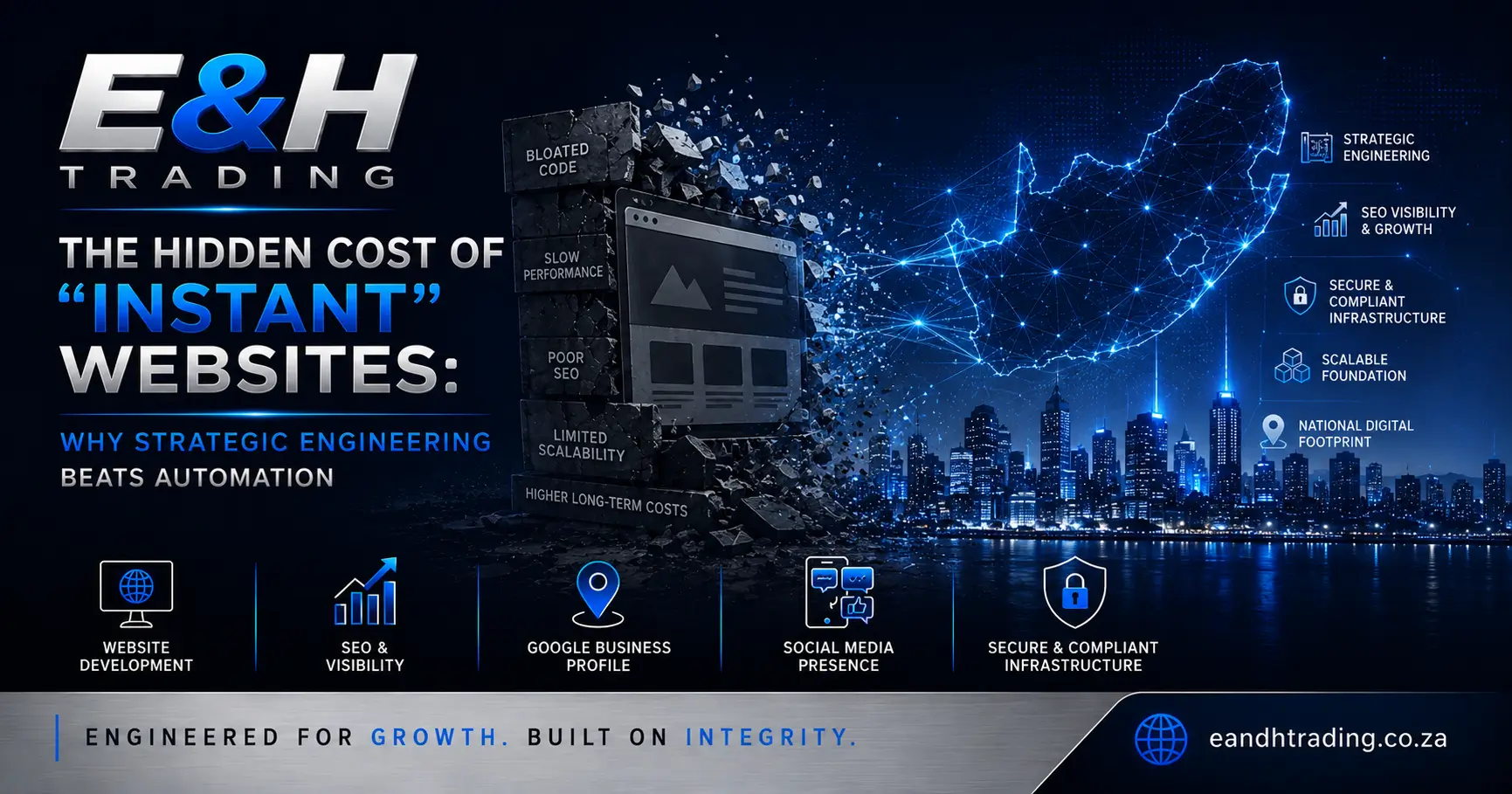
The Hidden Cost of “Instant” Websites: Why Strategic Engineering Beats Automation
The promise of a website deployed in 60 seconds is incredibly tempting. In today’s hyper-paced South African market, speed is frequently mistaken for strategic advantage. Automated builders and AI tools have democratized digital access, allowing any new venture to launch a digital presence with a single click. For a small enterprise trying to establish an immediate online footprint, the low initial cost and instantaneous results feel like a definitive victory.
However, as the digital landscape matures in 2026, the reality is starkly different. These “instant” digital solutions invariably come with catastrophic long-term trade-offs. While automation is a powerful operational assistant, a corporate website is not merely a collection of pixels and generated text—it is your primary lead generation asset and digital storefront. Understanding precisely where automation ends and strategic engineering begins is the fundamental key to building a digital footprint that actually captures market share and scales sustainably.
1. The Search Engine “Glass Ceiling” and Code Bloat
Modern search engines, particularly Google, have evolved into highly sophisticated evaluators of technical quality and user experience. While an AI builder can rapidly generate baseline meta-tags and generic descriptions, it fundamentally lacks the strategic capacity to understand localized search intent.
- The Strategic Edge: True search engine optimization (SEO) is not about rudimentary keyword placement. It is about intercepting and answering the specific queries of your target audience. Aggressive growth requires a deep understanding of local market nuances in South Africa—something a generic, globally trained algorithm completely misses. Relying exclusively on automated SEO tools guarantees your website will remain trapped on page three of the search results, rendering its “fast” launch entirely useless.
- The Reality of Bloated Architecture: To ensure their drag-and-drop templates function universally for millions of users, instant AI website builders rely on heavy, “bloated” codebases. This excessive, unnecessary code severely degrades your server response times and page load velocities. In an era where Google strictly enforces Core Web Vitals and penalizes slow websites, an instant website is a major technical red flag that actively destroys your national ranking potential.
2. The Danger of Brand Homogenization and Trust Erosion
If an algorithm is constructing your digital presence based on aggregated, popular data, it is utilizing the exact same design patterns, layouts, and copy structures for your direct competitors. This systemic recycling leads to the “homogenization of the web”—an endless sea of corporate sites that look, sound, and function identically.
In a highly competitive local market, your brand must assert immediate authority and stand out. Consumer trust is engineered through unique, frictionless design and a highly authentic, authoritative brand voice.
- The Trust Deficit: When a potential client navigates to a website that feels overtly “templated” or AI-generated, they instinctively question the legitimacy and professional depth of the business.
- Authentic Positioning: Consumers will consistently bypass a generic, automated facade in favor of a competitor whose digital footprint demonstrates actual investment, precise architecture, and professional integrity. A meticulously engineered digital presence that genuinely reflects your corporate values will always out-convert a polished but hollow automated output.

3. The Catastrophe of “Technical Debt” and the Scaling Wall
Perhaps the most dangerous and widely overlooked risk of automated website builders is the immediate accumulation of Technical Debt. These platforms operate exclusively as “closed systems” or “walled gardens.” They make it exceptionally easy to start, but functionally impossible to scale.
- Hitting the Scaling Wall: As your enterprise expands, your operational requirements will evolve. You will inevitably require custom API integrations, specialized client portals, advanced CRM connections, or complex e-commerce architectures.
- The Financial Cost of Rebuilding: Because instant builders lock you into their proprietary, unmodifiable code, you cannot implement custom engineering. When your business outgrows the basic template, you are forced to abandon the entire asset and start completely from scratch. The initial financial “saving” of an instant website transforms into a massive, crippling expense when a total rebuild becomes mandatory. Engineering your digital footprint on a standard, open-source, and highly flexible foundation from day one is the only financially responsible strategy.
4. Navigating the Legal, Security, and Compliance Landscape
The regulatory environment governing the internet is tightening aggressively, specifically regarding data privacy (such as the POPI Act in South Africa) and strict digital accessibility standards.
- Accessibility Failures: Instant, AI-generated sites frequently fail to meet fundamental WCAG (Web Content Accessibility Guidelines) out of the box. Ensuring your platform is usable for all individuals is not just a moral directive; it is rapidly becoming a strict legal requirement.
- Asset Ownership and Security: Furthermore, the legal reality of who actually “owns” AI-generated code and proprietary builder templates remains a highly volatile grey area. When you use a closed-system builder, you are effectively renting your digital presence. Absolute ownership of your digital assets—your server architecture, your underlying code, your database, and your content—is non-negotiable for the long-term security, valuation, and operational safety of your enterprise.
5. Why Nuance, Strategy, and Human Engineering Matter
At its absolute core, a corporate website is a precision tool for market communication and lead conversion. An automated system can arrange pixels and generate grammatically correct sentences, but it possesses zero strategic intuition. It does not know when to aggressively push a call-to-action or when to deploy subtle brand reinforcement. It fundamentally cannot comprehend the “vibe” of your specific sector or the nuanced pain points your South African clients are desperately trying to solve.
True digital dominance occurs exclusively at the intersection of high-performance technology and aggressive human insight. AI is an exceptional secondary tool for streamlining repetitive tasks or basic data processing. However, the high-level executive decisions—the structural architecture, the localized SEO strategy, the data security protocols, and the aggressive brand positioning—demand a hands-on, highly intentional engineering approach.
Closing Thoughts: Engineering for Longevity
Technology must relentlessly empower your corporate growth, not artificially restrict it. While the allure of deploying a website in 60 seconds is completely understandable for a novice, the objective of a serious enterprise must be to engineer an unbreakable foundation that supports scalable revenue for years, not days.
By prioritizing deep-level strategy and technical engineering over sheer, automated speed, you guarantee that your digital presence is as dominant, unique, and resilient as the business it represents. E and H Trading does not generate websites; we engineer national digital footprints built for absolute market authority.